26 April 2011

Do We Have Differest Taste Zones on Tongue?

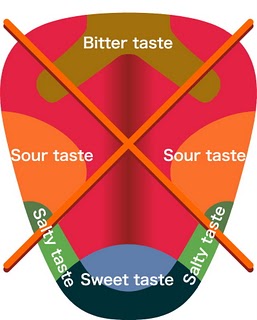
We all are familiar with the 'tongue map' concept which says we have got different areas of tongue that senses different tastes. It also says that there are four primary tastes namely sourness, sweetness, saltiness and bitterness. See the figure. It shows the areas on our tongue which are supposed to receive these primary tastes.
But how many of us know that it is utterly a false idea? Yes, of course it is. This century old misconception comes from the research paper of a German scientist D. P. Hanig published in 1901. Probably, it is the most popular false idea ever presented and Hanig owns the credit of misguiding generations for a century! It was only in 1974, Virginia Collins re-examined Hanig's findings. She does agree to Hanig in one concept; there are variations in sensitivity to the four basic tastes. But it is too small to have any practical significance. Collings found that all tastes can be detected anywhere there are taste receptors—around the tongue, on the soft palate at back roof of the mouth, and even in the epiglottis, the flap that blocks food from the windpipe. 
Another fact is, other than sweet, sour, salty and bitter, there is another fifth distinct taste. It can be called 'meaty' which is the taste associated with meats. It is the taste of glutamate.
It is a mystery why scientists didn't bother about this seemingly simple idea until 1974 and why on earth the text books print this idea even today. [Read more]



25 April 2011

Why Do Watches Always Show 10:10 in Ads?

Most of you must have noticed that the picture of watches in advertisements always show 10:10 on their dials. But do you know why is it so? There are so many rumors regarding this question. Some say, it is the time Abraham Lincoln was shot, some others say it is the time the inventor of wrist watch Patek Philip died. But none of these is true.
According to what Timex says, the answer is quite simple. When the time is fixed at 10:10, it gives the look of a 'smile' and the manufacturers want their products to be smiling at the customers. Another advantage is that in that position, the manufacturers' trademark or logo on the top of the dial is fully visible. Timex clocks always show exactly 10:09:36 in their ads. Later this became a custom to show 10:10 on all watches, and even digital watches show this time.
But it should be noted that there do are some companies whose watches show other times such as 08:20.

19 April 2011

How Many Senses We Got, Just Five?

Sometime when we say something from our intelligent guess work, we say for fun "You know, I've got sixth sense". What make us say so is the assumption that man has only six senses and extra sense is surely superhuman. But how many of us knows that we have got far more number of senses. I'm not talking about any para psychological concepts. Although definitions vary, physiologically number of senses we got varies from at least 9 to more than 20!
The five senses we always talk about are sight, smell, taste, touch and hearing. These five senses were identified and listed by Aristotle in the 300 BC's. But modern science has identified many more senses. I'll tell you a few examples I know:
1. Equilibrioception- It is the sense that prevents us from falling while walking and standing.i.e., the sense of balance and equilibrium[Read more]
2. Nociception- This is nothing but the sense of pain. When you touch a hot iron box, you are not sensing 'touch', are you? Pain is a different perception than touch.[Read more]
3. Proprioception- It is the sense that helps you know the position of your own body parts. Have you ever thought a 'sixth sense' is working when you take food directly to your mouth without mistake even if it is perfectly dark?[Read more]
4. Thermoception- This you might have guessed. Yes, it is the sense that helps us know the relative temperature.When you say, 'Oh the climate is too hot', your thermoceptive sense is working. The exact mechanism behind this sense is yet to be known.

Some other senses that I don't know the names are the senses of time, itching, pressure, hunger thirst, fullness of stomach, need for urination and defecation( Number 1 and number 2!) and blood carbon dioxide level. So next time when you joke about your sixth sense, remember, six is too small a number!

Moon and The Great China Wall

Many of you might have read somewhere that the only man-made thing that can be seen from Moon on Earth is the Great Wall of China. Didn't you? But did you know it is purely false? Yes it is. None of the Apollo travelers who were on moon reported such a thing. Other than the Apollo travelers, nobody has ever been to moon. Then who on earth did spread such a 'fact'? It was one Richard Halliburton. The funny thing is, first moon-landing happened on 1969 and Halliburton had died in 1939! Don't think that Halliburton was a lying silly crack. He is a legendary American adventurer and author.(Read more about him here) In his 'Second Book of Marvels' he says "Astronomers say that the Great Wall of China is the only man-made thing on our planet visible to the human eye from the moon". He doesn't say which astronomer told him so. Anyway that is the source of such a widely spread misconception.
 
The above picture is a satellite image of the Great Wall. Can you distinguish it from the surroundings? And when you know Moon is ten times farther than an artificial satellite from Earth, how is it possible to see The Great Wall from Moon? Should I talk more now?

15 April 2011

Vishu - The Astronomical New Year

First of all, very warm Vishu wishes to all...

I thought today I shall talk about the astronomical side of Vishu.
We all know that from Earth, Sun would appear to revolve around us. The ancient people believed Sun actually is revolving around Earth in a circular orbit. To locate sun in its orbit, they divided the 'solar orbit' around Earth, called the ecliptic, into twelve equal parts. To identify these parts in sky, they joined some of the stars in that portion of sky to make out a picture. Then they named each part according to the picture they made out in that portion. These twelve parts of sky on the sun's path around earth are called the twelve Raashi's(രാശികള്‍), named Medam, Idavam, Midhunam etc. The strip of sky around Earth that comprises of these twelve raashis is called the Zodiac(രാശിചക്രം). See the picture below:
As Sun takes 365 days to make a complete revolution, it is trivial to see that it spends around 30 days (365 days/12) in a particular Raashi. Our Malayalam calendar is based on this concept. That is, our Medamaasam(മേടമാസം) is that period of the year during which Sun is in Medam raashi. The day on which Sun moves from one raashi to another is called Sankraanthi(സംക്രാന്തി). Vishu is astronomically the Medasankraanthi(മേട സംക്രാന്തി), that is, the day on which Sun enters Medam raashi.
Historically, Medam 1 is the beginning of Malayalam calendar. But most of us consider Chingam 1 as New Year which is the beginning of Kollavarsham(കൊല്ലവര്‍ഷം). This is believed to be started by the King of Kollam (Venad Udaya Marthanda Varma) who thought Chingam, the season of harvest, can be the beginning of a new year. Chingam has no astronomical significance. In another post, I had talked about the equinoxes when sun rises exactly in the East. At the latitude where Kerala is, it is around Medam 1 sun rises exactly in the East. So Vishu in Kerala represents Vernal Equinox.('vishu' in Sanskrit means 'equal').
So Vishu is the astronomical new year in Kerala. Once again, Happy Vishu to all